

Firefly Chandelier: How to Choose the Size and Hang It Right
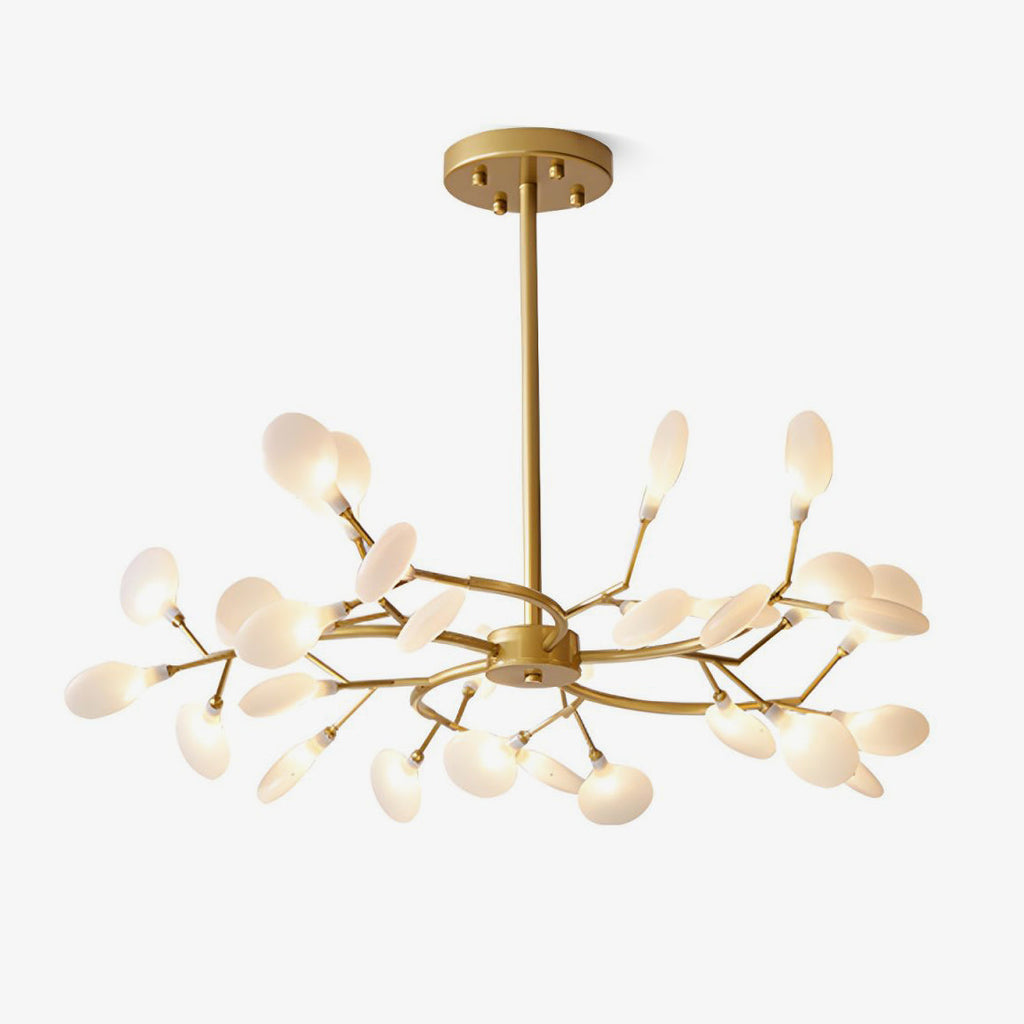
The Firefly chandelier is a sputnik-style ceiling fixture built from a metal and iron frame with dozens of white acrylic spheres, available in gold or black and in four sizes from 27.6 to 40.6 inches across. It suits dining rooms, living rooms and bedrooms where you want a sculptural focal point rather than a shaded pendant — and because it uses small G4 bulbs, the light reads as dozens of soft points rather than one bright source.
If you are choosing between sizes, hanging heights or bulb types, this guide walks through each decision in the order you will actually make it.
Quick answer: Match the fixture diameter in inches to the sum of your room's length and width in feet (a 12 × 14 ft room points to roughly 26 in. or more). Hang the bottom of the fixture 30–36 in. above a dining table, or no lower than 7 ft above the floor in a living room. Use G4 LED bulbs in 2700–3000K for a warm, even glow.
What the Firefly chandelier actually is
This is an open, branch-like chandelier: a metallic frame extends outward in irregular directions, and each tip carries a small white acrylic sphere. There is no shade and no diffuser over the whole fixture, so the silhouette stays airy and the ceiling behind it remains visible. That is the main reason it works in rooms where a large drum pendant would feel heavy.
The design is described as satellite-inspired with firefly-like accents — an architectural, slightly futuristic look that still reads as warm once the bulbs are lit. It is a hardwired fixture, not a plug-in, so it replaces an existing ceiling light rather than sitting alongside one.
Who it is for
- Dining rooms that need a centerpiece above the table without blocking sightlines across the room.
- Living rooms with standard flat ceilings and a seating arrangement that gathers under one light.
- Bedrooms in the smaller sizes, where a low-profile sculptural fixture is preferable to a fabric shade.
- Restaurant or hospitality spaces — the product is explicitly listed for restaurant use as well as residential rooms.
It is not the right choice for a bathroom, a covered porch or any damp location: the fixture carries an IP20 rating, which means indoor, dry use only.
Design and materials
The frame is metal and iron, finished in either gold or black. The spheres are white acrylic — lighter than glass, and less likely to arrive chipped. Because the acrylic is opaque white rather than clear, the bulbs inside glow through it instead of being directly visible, which softens the glare you would get from bare G4 lamps on an open sputnik frame.
Two practical consequences of that construction:
- Weight and ceiling load: an open metal frame with acrylic spheres is lighter than an equivalent glass chandelier, which is helpful on standard joists — but it is still a hardwired fixture and should be mounted to a properly rated electrical box.
- Cleaning: acrylic spheres wipe clean with a dry or slightly damp cloth. Avoid solvent cleaners, which can cloud the surface.

Choosing the right size
The fixture comes in four head counts, all with the same 35 cm (13.8 in.) body height. Only the diameter changes:
| Size | Diameter | Body height | Best fit |
|---|---|---|---|
| 30 heads | 70 cm / 27.6 in. | 35 cm / 13.8 in. | Small dining rooms, bedrooms, compact living areas |
| 45 heads | 83 cm / 32.7 in. | 35 cm / 13.8 in. | Dining tables for six, medium living rooms |
| 54 heads | 91 cm / 35.8 in. | 35 cm / 13.8 in. | Larger dining rooms, open-plan living areas |
| 63 heads | 103 cm / 40.6 in. | 35 cm / 13.8 in. | Great rooms, large open spaces, statement entryways |
A reliable starting rule: add the room's length and width in feet and treat that number as the minimum diameter in inches. A 14 × 16 ft living room gives 30, so the 45-head (32.7 in.) or 54-head (35.8 in.) version is the safer choice. In a dining room, the fixture should also span roughly one-third to one-half of the table's length so it feels anchored rather than floating.
One caveat on very tall rooms: the included rods total about 50 cm (19.7 in.), made up of a 20 cm and a 30 cm section. In a room with ceilings well above 9 ft, you may need additional suspension length, so confirm availability with the store before ordering rather than assuming a longer rod is included.

Placement and installation
Hanging height by room
- Above a dining table: 30–36 in. (76–91 cm) from the tabletop to the lowest point of the fixture. With an 8 ft ceiling, aim for the lower end of that range; with 9–10 ft ceilings, the upper end keeps the fixture from feeling low.
- Living room, no table underneath: keep the lowest point at least 7 ft (213 cm) above the floor so people can walk beneath it.
- Bedroom: center it over the foot of the bed or the open floor area rather than directly over pillows, and keep the same 7 ft clearance.
Center the fixture on the room or on the table — not on the nearest doorway. In an open-plan space, center it over the seating or dining zone it is meant to serve rather than over the whole floor plate.
What installation involves
This is a hardwired ceiling fixture rated for AC 110–240V. It mounts flush to the ceiling via a canopy and suspends on the included rods. The product is specified for flat ceilings; for a sloped ceiling, have an electrician assess whether the canopy can sit correctly before buying.
Control is through a standard wall switch, which is not included. Dimming behavior is not specified for this fixture — if dimming matters to you, confirm with an electrician and use dimmable G4 bulbs rather than assuming the circuit supports it.
Because the spheres are individual pieces on a wide frame, allow time for assembly and plan for two people during mounting. A licensed electrician is the right call if you are not confident working at the breaker panel.
Shop Now — see finishes and sizes →
Bulbs, color temperature and light quality
The fixture takes G4-base bulbs, either LED or Edison-style. Bulb wattage limits are not stated on the product page, so check with the store before choosing high-output lamps — this is the one specification worth confirming rather than guessing.
Some practical guidance that does not depend on wattage:
- Color temperature: 2700K for dining rooms and bedrooms, where warm light flatters skin tones and wood. 3000K if the room doubles as a kitchen or workspace and you want a slightly crisper feel.
- Consistency: buy all bulbs in one order and from one batch. With dozens of small lamps, a mismatch in color temperature is far more visible than on a single-bulb fixture.
- Output: as a rough starting point, plan for roughly 20–30 lumens per square foot of floor area across the whole fixture. Because each G4 bulb contributes only a few hundred lumens, the larger head counts exist partly to reach that total.
- CCT and dimming: if you fit smart or dimmable G4 bulbs, verify they are compatible with your switch type — low-voltage-style G4 lamps can behave unpredictably on older dimmers.
Gold or black?
Both finishes use the same white acrylic spheres, so the difference is in how the frame reads against the ceiling. Gold warms up a room with cream, walnut, brass or terracotta tones and tends to disappear slightly against a white ceiling. Black gives more graphic contrast and suits rooms with dark window frames, steel, or a monochrome palette. In a room with very low ceilings, the lighter finish usually feels less heavy overhead.

How it fits different interiors
Despite the "mid-century modern" name, the shape is closer to a sputnik chandelier — which is why it slips into more styles than the label suggests.
- Mid-century and contemporary: the most obvious pairing. Keep the rest of the room quiet and let the fixture carry the visual weight.
- Modern organic: the branch structure echoes plant forms; pair with linen, rattan and matte ceramics.
- Minimalist: works if the ceiling is uncluttered. It is a statement piece, so it needs empty space around it to read properly.
- Traditional rooms: possible in a black finish as a deliberate contrast, but it will look like an intervention rather than a match.

One styling note: because the light comes from many small points, the fixture throws a soft, scattered pattern rather than a single pool of light. That is flattering over a dining table and less useful as task lighting over a kitchen island — plan supplemental lighting if you need to work under it.
Certifications and safety
The fixture is listed as UL certified, ETL listed, CE approved, RoHS compliant and FCC certified. For a hardwired ceiling light in the US, UL or ETL listing is the relevant mark to look for — it means the fixture has been evaluated against a recognized safety standard, which matters both for insurance and for passing an electrical inspection.
Discover the Firefly chandelier →
Frequently asked questions
What bulbs does the Firefly chandelier use?
G4-base bulbs, either LED or Edison-style, on AC 110–240V. The number of bulbs matches the head count of the size you choose.
Can it be mounted on a sloped ceiling?
No — it is designed for flat ceiling mounting. On a vaulted or angled ceiling, have an electrician confirm whether the canopy can be adapted before purchasing.
Can I use it in a bathroom or outdoors?
No. The rating is IP20, which means indoor dry locations only. Moisture and outdoor exposure are outside its intended use.
Which size should I order?
Add your room's length and width in feet; that total is a reasonable minimum diameter in inches. Then check that the fixture spans about a third to a half of your dining table's length. When in doubt between two sizes in a large room, go larger — a small chandelier in a big room reads as undersized.
Is the chandelier dimmable?
Dimming is not specified for this fixture, and it is controlled by a standard wall switch (not included). If dimming is important, confirm with an electrician and use dimmable G4 bulbs.
Does it come with a warranty?
LampCozy lists a 5-year warranty on its lighting fixtures. Confirm the current terms with the store at the time of purchase.
-
Posted in
Buying Guide, Chandeliers, Dining Room Lighting, Living Room Lighting